
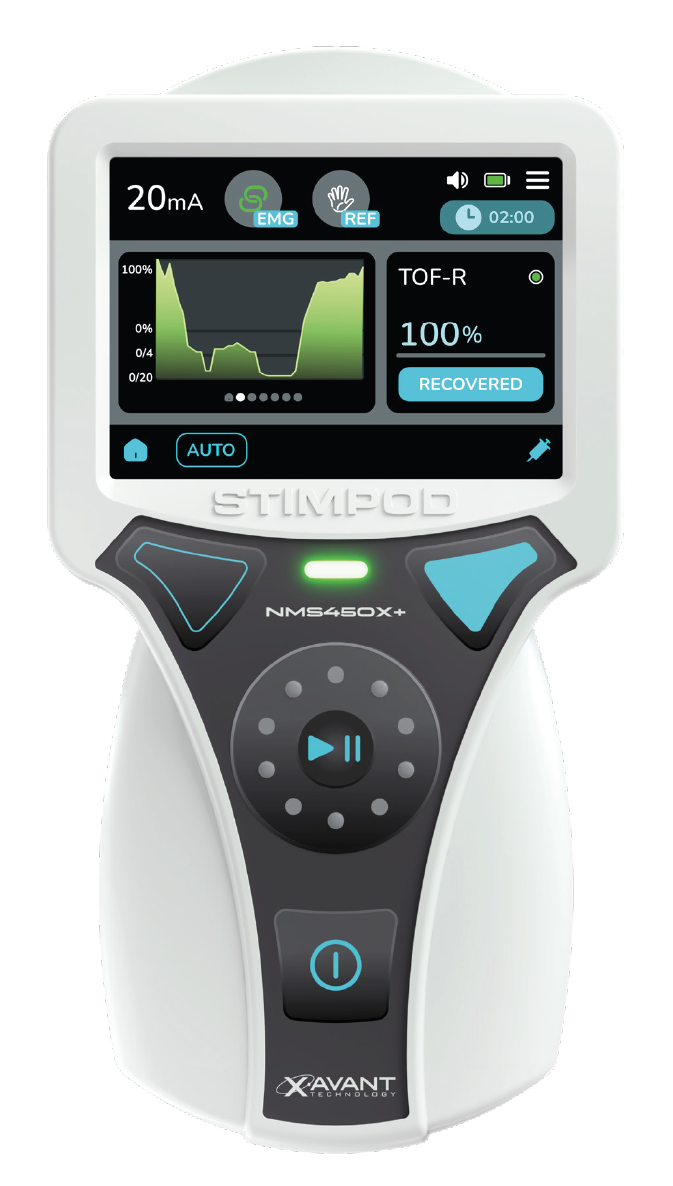
Set up, and start monitoring.
Three views to follow the whole case: the waveform, the ratio and the trend.
Apply the electrode, press start, and you are monitoring.
No baseline calibration for the AMG sensor, and no waiting for one. The reading is quantitative.
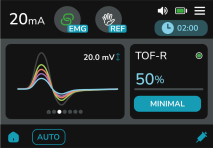
EMG waveform
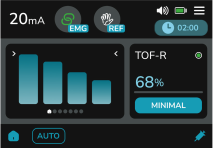
Quantitative TOF
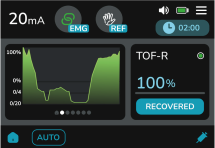
Full-case trend
A key recovery threshold in the guidance. Interpretation depends on the monitoring method.
Make recovery measurable.
An objective train-of-four ratio complements clinical assessment. Above approximately 0.4, fade becomes difficult to distinguish by sight or touch. Quantitative measurement provides the numerical response.36
Residual neuromuscular block remains a recognised clinical problem.12 Use the measured response alongside the full clinical assessment.
Read the guidance →Reversal is not measurement.
A multicentre study across five university-affiliated teaching hospitals compared residual block after neostigmine and after sugammadex, in a setting where dosing was not guided by neuromuscular monitoring. Train-of-four ratio was measured after tracheal extubation.
Sugammadex reduced residual block. It did not remove it.
Kotake Y, Ochiai R, Suzuki T, et al. Reversal with sugammadex in the absence of monitoring did not preclude residual neuromuscular block. Anesthesia & Analgesia 2013;117(2):345–351.5 Prospective multicentre observational study conducted in Japan, where routine practice at the time did not involve monitoring devices to guide dosing. The authors concluded that the finding underscores the importance of neuromuscular monitoring even when sugammadex is used.
Neuromuscular recovery rests on a number, not an estimate.
The Stimpod NMS450X+ measures the train-of-four ratio objectively and records it, so recovery is demonstrated and documented before extubation.
Documented recovery before extubation: from 1% to 93%.
What changed in one department that put quantitative monitors in every anaesthetising location and built a practice-change programme around them: equipment trials, education, clinical decision support with real-time alerts, and an ongoing performance metric.
Reversal reduces the risk. Only measurement tells you about the patient in front of you.
Weigel WA, Williams BL, Hanson NA, et al. Quantitative neuromuscular monitoring in clinical practice: a professional practice change initiative. Anesthesiology 2022;136(6):901–915.7 A single-centre retrospective review of a practice change programme, not a randomised trial. The figures above are documentation of recovery before extubation, which is a process measure: the authors are explicit that it is an intermediate outcome and only one of many factors contributing to patient outcomes.
Choose the sensor that fits the case
One device, two monitoring technologies. Select on surgical setup and clinical need.
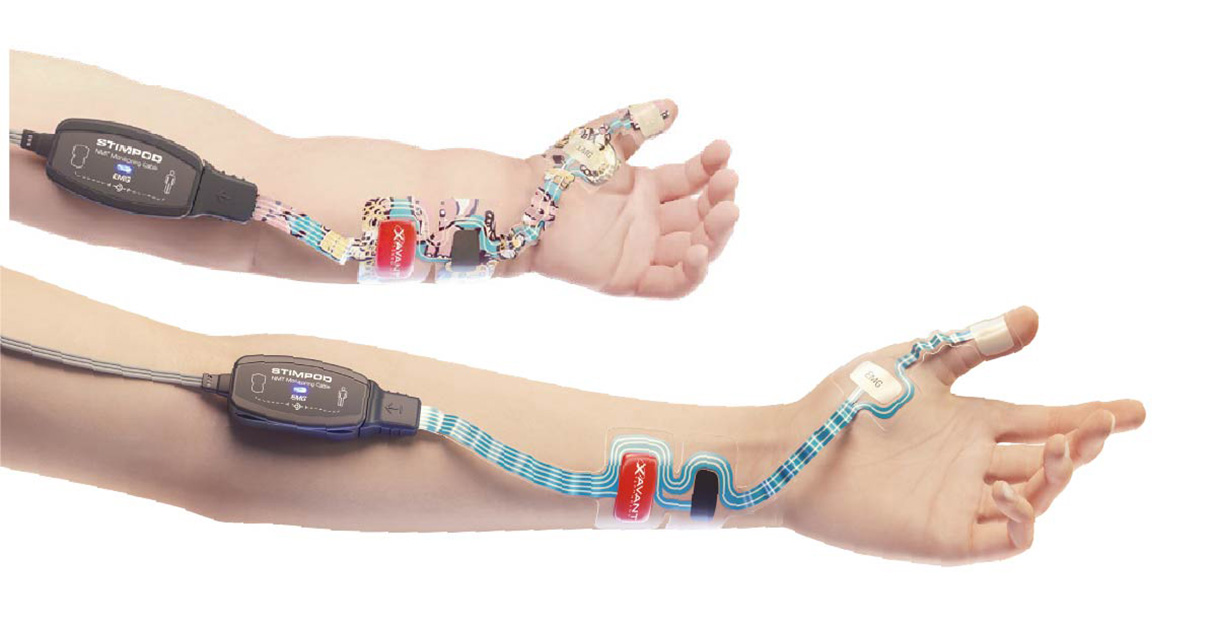
EMG does not depend on free thumb movement. It measures the muscle's electrical response, which makes it an option when the arm is tucked or access to the hand is restricted. The flexible electrode fits the left or right hand, maintains adhesion through long procedures with frequent patient movement, and provides continuous closed-circuit confirmation. Single-use. Adult and paediatric sizes.
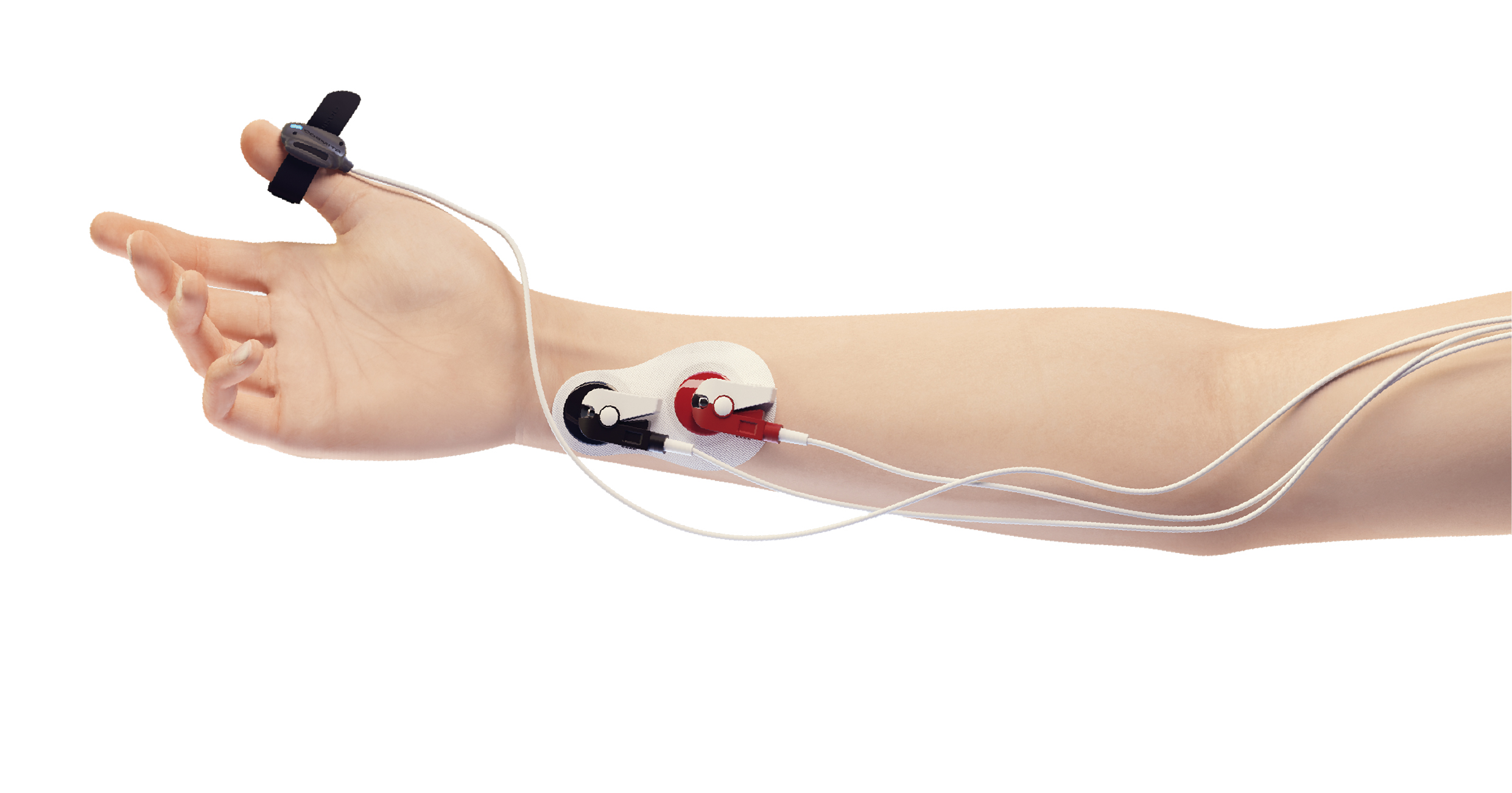
A reusable three-axis sensor measures the response through movement, so the thumb needs to be free. No baseline calibration is required for the AMG sensor, and it takes standard ECG electrodes your hospital already stocks. Three monitoring points: hand at the ulnar nerve, toe at the posterior tibial nerve, face at the facial nerve.
Monitoring site matters. For assessment of recovery before extubation, the guidance below specifies the adductor pollicis.
What the guidelines recommend
Both UK and European guidance set the same threshold.
Association of Anaesthetists
Quantitative neuromuscular monitoring whenever neuromuscular blocking drugs are given, continued until a train-of-four ratio above 0.9 is confirmed.3
European Society of Anaesthesiology and Intensive Care
Continue quantitative monitoring until a train-of-four ratio of more than 0.9 has been attained, measured at the adductor pollicis.4
Two bodies, one recovery target: above 0.9, confirmed quantitatively. Apply the guideline threshold for the measurement method and site.
In practice that means a device that produces the ratio objectively and records it. Not a stimulator, and not an inference from the dose given.
Connect monitoring to your workflow.
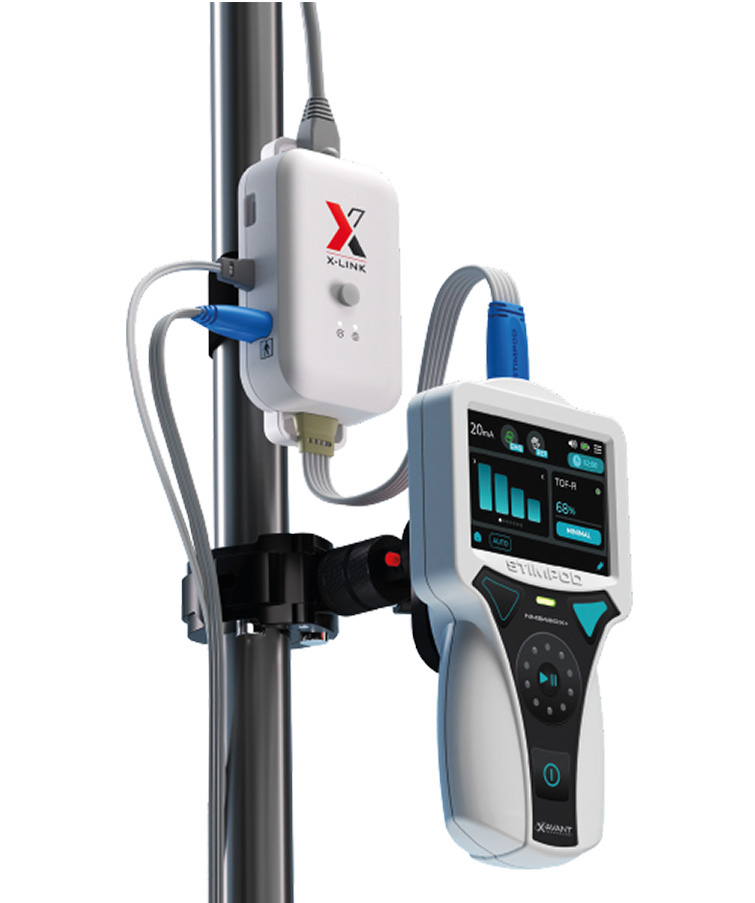
Hospital records. The optional X-Link module connects the Stimpod directly to your hospital record system, supporting HL7 and FHIR, with smart charging and real-time data transfer. Confirm interfaces, accessories and local installation with your clinical engineering or IT team.
No third-party middleware required. IHE standards supported. Flexible mounting for an IV pole or permanent installation.
Specifications
Detailed information for procurement and clinical evaluation.
Device
EMG electrode
AMG sensor
X-Link integration
See the Stimpod NMS450X+
in your theatre.
Arrange a trial or clinical demonstration with the LP Med team.
Opens an email to info@lpmed.co.uk. It helps to include your hospital, the theatres involved and rough timing.